

Learn what explosive air decking is, how free-fall activated spacers work in open-pit mines, and why this blast optimization technique improves fragmentation while reducing costs.
Slug: what-is-explosive-air-decking-free-fall-spacer-open-pit
---
What Is Explosive Air Decking and Why Do Open-Pit Mines Use Free-Fall Activated Spacers?
If you work in open-pit mining, quarrying, or surface blasting, you have likely heard of explosive air decking. But what exactly is it, and why are more operations turning to free-fall activated spacers to make it work? This article explains the fundamentals in clear, practical terms.
What Is Explosive Air Decking?
Explosive air decking is a blasting technique where air gaps are intentionally created within the explosive column inside a borehole. Instead of filling the entire hole with explosive material, the charge is divided into segments separated by empty spaces filled with air.
Think of it like this: a conventional blast hole is a continuous column of explosive from bottom to top. An air-decked hole has explosive at the bottom, then a gap of air, then more explosive, then another gap, and so on. These air gaps are called "air decks."
Why Put Air in a Blast Hole?
It might seem counterintuitive to leave parts of a blast hole empty. After all, explosives break rock - why reduce the amount? The answer lies in energy management.
When explosives detonate, they release enormous energy in the form of shock waves and gas pressure. In a fully loaded hole, this energy is concentrated in one continuous burst. With air decking:
- The energy is staged and distributed more evenly
- The shock wave reflects off the air gap boundaries, enhancing cracking
- Gas pressure has more time to work on the rock mass
- The total explosive needed is reduced while maintaining breakage effectiveness
Benefits of Air Decking in Open-Pit Mines
1. Better Fragmentation
Air decking helps create more uniform rock breakage. The reflected shock waves and staged gas expansion produce a more controlled fragmentation pattern, reducing oversized boulders and improving diggability.
2. Reduced Explosive Consumption
By replacing portions of the explosive column with air, mines can reduce total explosive use by 15-25% while achieving similar or better blast results.
3. Lower Blast Vibration
Less explosive mass means less ground vibration. This is critical for mines near communities, infrastructure, or sensitive geological formations.
4. Improved Throw Control
Air decking can influence the direction and distance of rock throw. This helps control muck pile placement and reduces the risk of flyrock.
5. Cost Savings
Lower explosive use, reduced secondary breaking, and better loading efficiency all contribute to lower cost per ton of material moved.
The Role of Free-Fall Activated Spacers
Creating air decks sounds simple in theory, but doing it reliably in a 15-meter deep borehole is challenging. This is where free-fall activated spacers come in.
A free-fall activated spacer is a specially designed device that is dropped into the borehole during the charging process. It falls under gravity to the desired depth and creates a stable physical barrier that separates explosive segments. The air gap forms naturally between the spacer and the explosive above and below it.
Why "Free-Fall Activated"?
The term "free-fall activated" refers to the placement method. Unlike systems that require manual positioning, mechanical insertion, or inflation, these spacers are designed to descend smoothly under their own weight. Once they reach the target location, they remain in place to maintain the air gap integrity.
This simple activation method offers several advantages:
- No special equipment needed beyond standard charging tools
- Fast placement (seconds rather than minutes)
- Consistent positioning across many holes
- Reduced labor and training requirements
- Reliable performance in various hole conditions
How Spacers Create Effective Air Decks
The effectiveness of an air deck depends on its size, position, and stability. Free-fall activated spacers are engineered to:
- Match common borehole diameters for secure fit
- Provide sufficient length to create meaningful air gaps (typically 0.5 to 2.5 meters)
- Support the weight of the explosive column above without collapsing
- Resist moisture and borehole contaminants
- Maintain dimensional stability until detonation
Typical Application in a Blast Hole
Here is how a typical air-decked blast hole is loaded using a free-fall activated spacer:
Step 1: Drill borehole to design depth (e.g., 12 meters)
Step 2: Clean hole and verify depth
Step 3: Load bottom explosive charge (e.g., 3 meters of bulk emulsion)
Step 4: Drop free-fall activated spacer into hole (creates 1.5m air gap)
Step 5: Load top explosive charge (e.g., 4 meters of ANFO)
Step 6: Apply stemming material to collar (e.g., 3.5 meters of drill cuttings)
Step 7: Connect initiation system and fire according to blast design
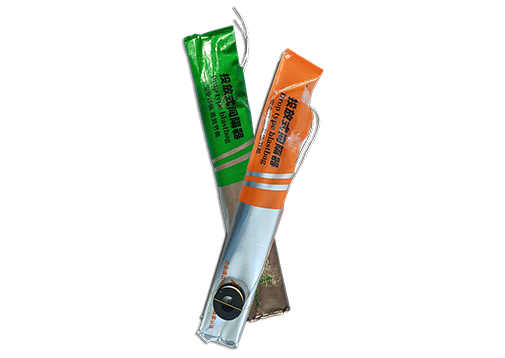
When the blast fires, the detonation sequence uses the air gap to optimize energy distribution, producing the desired fragmentation and movement pattern.
Who Uses This Technology?
Free-fall activated spacers for air decking are used in:
- Hard rock open-pit mines (copper, gold, iron ore)
- Quarrying operations (limestone, granite, basalt)
- Coal surface mines
- Construction blasting projects
- Any operation where blast optimization and cost control are priorities
Key Considerations for Implementation
Before adopting free-fall activated spacers, consider:
- Borehole diameter and whether standard spacer sizes are compatible
- Rock type and whether air decking suits your geological conditions
- Current explosive consumption and potential savings
- Blast vibration limits and regulatory requirements
- Loading procedures and crew training needs
- Integration with existing blast design software
Conclusion
Explosive air decking is a proven technique for improving blast performance in open-pit mines, and free-fall activated spacers make it practical and reliable. By creating controlled air gaps within the explosive column, these simple devices help mining operations achieve better fragmentation, lower costs, and improved environmental compliance. For any mine looking to optimize its blasting program, understanding and implementing air decking with free-fall spacers is a worthwhile investment.
Keywords: what is explosive air decking, free-fall activated spacer explained, air decking in mining, blast hole air gap, open-pit mine blasting technique, how does air decking work, mining blast optimization, explosive charge separation, bench blasting air deck, mining fragmentation control
This website uses cookies to ensure you get the best experience on our website.
 中文
中文



 WhatsApp
 Phone
Phone
Comment
(0)